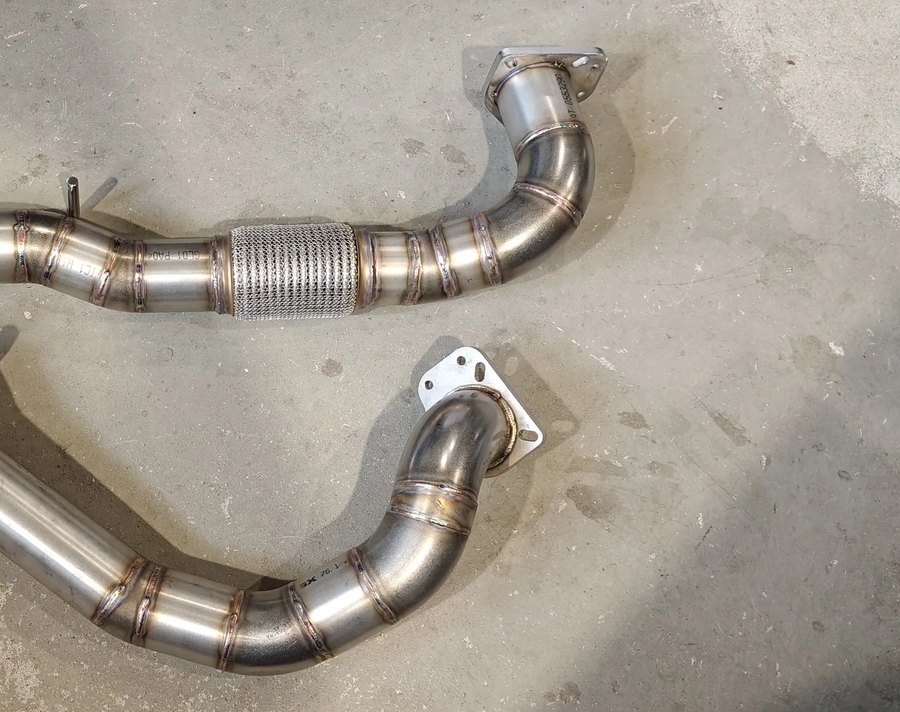
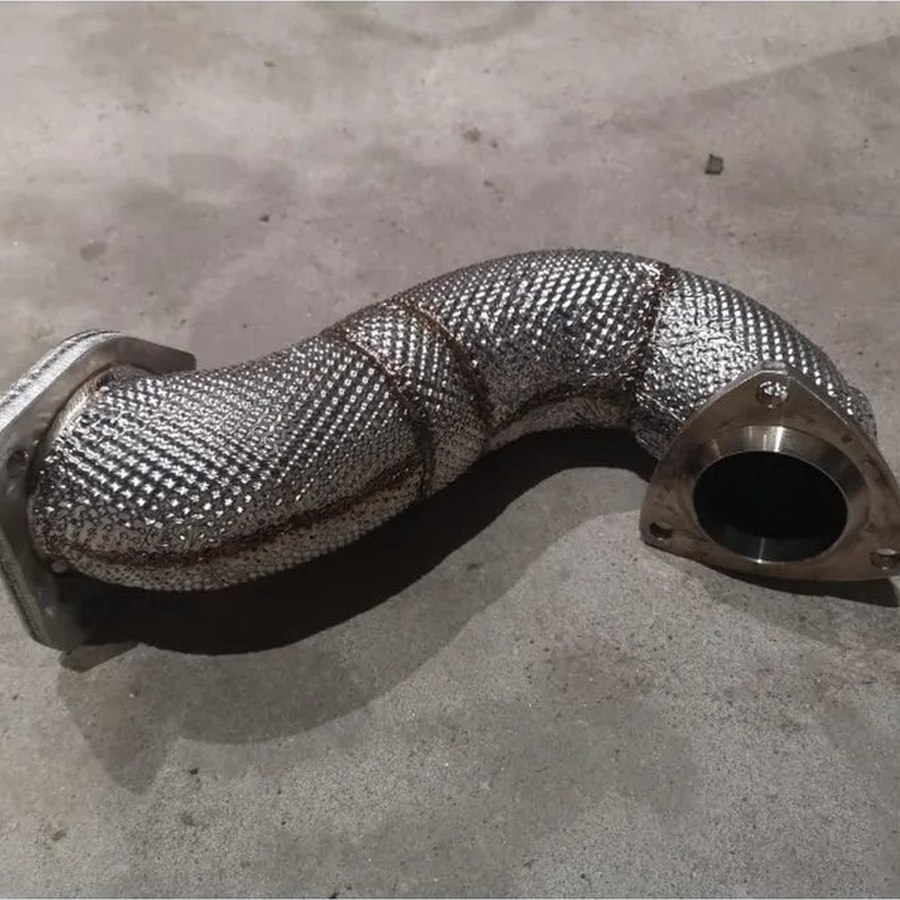
Diameter, catalyst, sensors and flanges. Four decisions that determine whether a downpipe delivers power or just noise and a warning light on the dashboard.
The downpipe is the first exhaust component behind the turbo and at the same time the biggest restriction in the whole system. The factory one has a densely packed catalyst there and a narrowing below it — hence all the fuss about replacing it. The problem is that “bigger” does not always mean “better”.
Diameter: matched to power, not to looks
A pipe that is too large reduces exhaust gas velocity, and with it the energy returning to the turbo at low rpm. The result: the car comes on boost later than on the stock system, even though the peak looks good on the dyno.
| Power | Recommended diameter | Notes |
|---|---|---|
| up to 300 hp | 70 mm | usually enough; at 76 mm you lose the bottom end of the curve |
| 300–450 hp | 76 mm | the most popular choice for a typical stage 2 |
| 450–600 hp | 83 mm | usually requires reworking the mid section |
| over 600 hp | 89 mm and above | an individual project, calculated for the specific turbo |
If you are planning further upgrades, size the diameter for the target power rather than the current one — replacing the downpipe a year later costs as much again as the first purchase.
Catalyst: 100 cpsi, 200 cpsi or none
The cpsi figure (cells per square inch) tells you how many channels the core has per square inch. The fewer there are, the lower the flow restriction and the weaker the exhaust gas treatment.
- 200 cpsi — the compromise. The restriction is barely higher than with an empty pipe, and the diagnostic sensor usually does not object.
- 100 cpsi — the choice for stronger builds. More often it requires moving the sensor or recalibrating the software.
- no catalyst — a track solution. In a car driven on public roads it means non-compliance with the regulations and trouble at the roadworthiness test.
A catless version is not “the same thing, only lighter”. It is a decision that closes off the legal use of the car — worth taking deliberately rather than in passing.
Lambda sensor: the most common source of a fault code
The diagnostic sensor (the second one in line) compares the composition of the exhaust gases before and after the catalyst. When the catalyst is less dense or absent altogether, the difference disappears and the ECU reports a catalyst efficiency fault. The solutions, best first:
- software recalibration — switching off the catalyst monitor by whoever writes the map; the only solution that does not lie to the sensors,
- a spacer with a mini catalyst — moves the sensor out of the exhaust stream; works on some cars,
- a plain mechanical spacer — the cheapest and the least reliable; the fault code comes back after a few cycles.
Flanges and fitment
This is what decides whether the installation takes an hour or half a day. What to look at:
- the thickness of the flange at the turbo — 8 mm stays flat through many heat cycles, 5 mm can warp,
- retained factory mounting points and hangers — a missing hanger of its own ends in stress on the turbo flange,
- sensor bosses in the original positions, so that the loom reaches without extensions,
- allowance for thermal expansion at the joint with the mid section.
Material
304 stainless steel is the standard: corrosion resistant, easy to weld, able to take the temperatures of a typical petrol engine. In the section at the turbo, where temperatures are highest, 321 makes more sense — titanium stabilised, less prone to intergranular corrosion. 409 and aluminised steel are cheaper, but in Polish conditions, with salt on the roads, their service life is counted in seasons rather than years.
Before you buy
- Check the engine code, not just the model of the car — the same body often comes with several versions running different turbos.
- Decide on the target power and size the diameter for it.
- Decide on the catalyst knowing the legal consequences.
- Ask whether a software recalibration will be needed — and budget for it.
If you are unsure about any of these points, write to us with the engine code and a list of the modifications on the car. We will reply with a specific part number, or tell you that in this configuration it is not worth it.